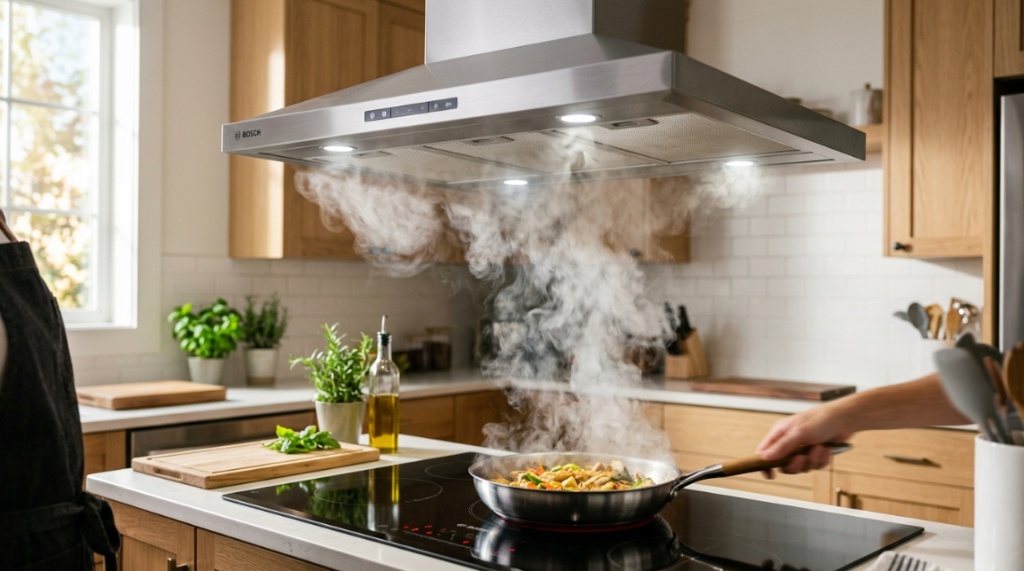
You’ve just seared a perfect steak, and now your kitchen looks like a scene from a foggy mystery novel. The smoke alarm is wailing, your eyes are stinging, and the smell of burnt oil is clinging to every curtain in the house. If this scenario sounds painfully familiar, you aren’t alone. Most home cooks quickly realize that the standard recirculating hoods found in builder-grade kitchens simply cannot handle heavy smoke production. The real problem is that smoke isn’t just an annoyance—it contains grease, volatile organic compounds (VOCs), and fine particulates that settle on your cabinets and damage your lungs. To truly solve this, you need a ventilation system that captures and expels smoke before it spreads, rather than just filtering it poorly.
What Makes a Range Hood Effective at Removing Smoke?
The most effective range hood for smoke removal uses a powerful motor to capture dirty air and a ducted system to expel it entirely outside your home. Without ducting, you are simply recycling smoke through a charcoal filter, which does not remove heat, moisture, or most fine particles.
The Critical Difference Between Ducted and Ductless Systems
A ducted hood captures smoke at the source and pushes it through a pipe to the outdoors. This is the only reliable method for eliminating smoke, grease, and odors completely. Ductless (recirculating) hoods pass air through a charcoal filter and blow it back into the room. While cheaper to install, they fail to remove humidity and most smoke particles, making them useless for heavy cooking.
Why Cubic Feet per Minute (CFM) Matters for Smoke
CFM measures how much air the fan can move per minute. For smoke-heavy cooking like frying, searing, or stir-frying, you need a minimum of 600 CFM. For professional-grade ranges or wok cooking, 900–1,200 CFM is recommended. If you cook with a gas stove, your hood also needs to handle combustion byproducts like carbon monoxide, which requires even higher CFM.
The Role of Capture Area and Depth
A hood that is too small will let smoke escape around the edges. Your hood should be at least as wide as your cooktop, and ideally 3–6 inches wider on each side. Depth is equally important. A standard 18-inch deep hood often misses the front burners. Look for a 21-inch or deeper canopy to cover front and rear burners.
Which Type of Range Hood Is Best for Smoke-Heavy Cooking?
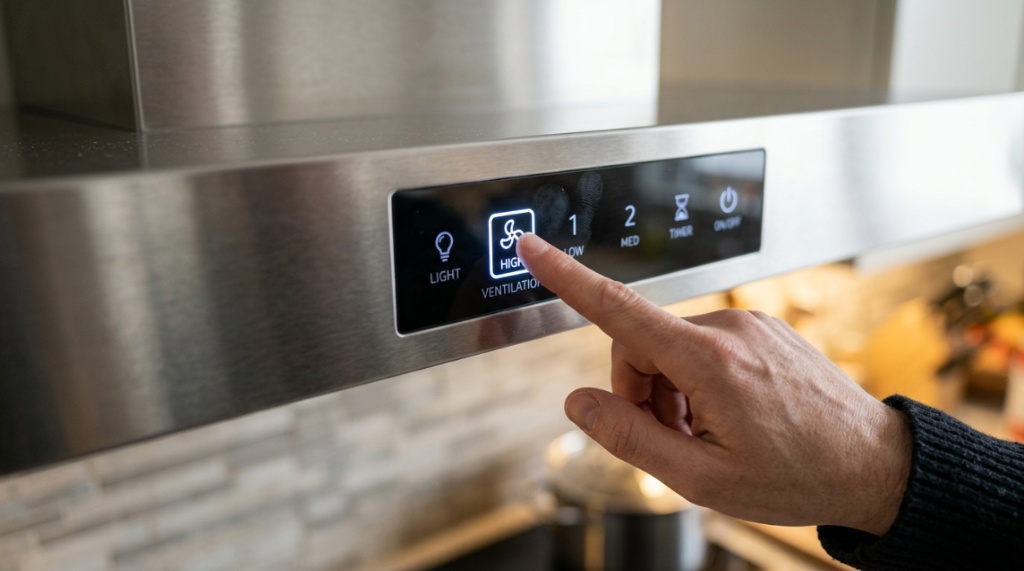
For smoke-heavy cooking, a powerful under-cabinet hood or an island hood with a high CFM rating and ducted ventilation is the best choice. However, the best style often depends on your kitchen layout and budget.
Under-Cabinet Hoods for Smoke Removal
Under-cabinet hoods are the most common option for standard kitchens. When choosing one for smoke, skip the basic models (under 400 CFM) and look for units with 600–900 CFM. Brands like Zephyr and Broan offer models with baffle filters, which handle grease better than mesh screens. Baffle traps capture grease droplets more efficiently and reduce smoke blow-by.
Wall-Mounted Chimney Hoods
Chimney hoods sit against the wall and offer more airflow power. They are excellent for gas ranges because they can accommodate tall ductwork. Look for models with stainless steel baffle filters and a CFM rating over 800. These hoods also do a better job of capturing smoke rising from front burners due to their deeper canopy depth.
Downdraft Ventilation Systems
Downdraft vents rise from behind or beside the cooktop and pull smoke downwards. While they seem convenient for island kitchens, they are significantly less effective at capturing smoke than overhead hoods. Smoke naturally rises, and downdraft systems fight physics. Only choose this option if an overhead hood is absolutely impossible to install.
How Loud Is Too Loud for a Smoke-Fighting Hood?
Noise is measured in sones. A range hood that is effective at removing smoke will inevitably be louder than a weak one, but you should aim for a unit that runs below 6.0 sones at full speed. Any louder, and conversation becomes difficult.
Understanding Sones vs. Decibels
Sones are a linear measurement of loudness. One sone is about the volume of a quiet refrigerator. A hood running at 4–5 sones is moderate (like light traffic), while 7+ sones is loud (like a vacuum cleaner). For smoke removal, you need high CFM, but look for hoods with “quiet” motors or variable speed controls that let you run a low speed for simmering.
Why Motor Placement Affects Noise
External blowers (motors mounted on the roof or exterior wall) are the quietest because the motor noise stays outside. Inline blowers installed inside the ductwork are also quieter than internal blowers. If noise is a major concern, invest in a hood with an external blower kit.
Which Filter Type Removes Smoke Best?
Baffle filters are the best choice for smoke removal. They use metal slats to trap grease and allow air to pass through, while mesh filters (which are cheaper) tend to clog quickly and allow smoke to pass through.
Baffle Filters vs. Mesh Filters for Smoke
Baffle filters catch grease by forcing air to change direction rapidly. This makes them highly effective at capturing the sticky particles in smoke. Mesh filters rely on multiple layers of fine wire, which can clog within a few cooking sessions and reduce airflow significantly. For heavy smoke, always choose baffle filters.
Charcoal Filters and Smoke Recirculation
If you absolutely must use a ductless hood (rental apartments, for example), look for hoods with large, replaceable charcoal filters. However, understand that charcoal filters primarily remove odors, not smoke particulates. They become saturated quickly and need replacement every 3–6 months to maintain any effectiveness. If you are designing an open-air entertainment space, proper ventilation is just as crucial outdoors as it is indoors especially when planning a layout like a diy outdoor kitchen that requires heavy-duty grilling smoke management.
What Size Range Hood Do I Need for Smoke Control?
Your hood should be 6 inches wider than your cooktop. For a 30-inch stove, buy a 36-inch hood. The depth should be at least 21 inches to cover front burners. This ensures that the capture area encloses all rising smoke before it drifts into the room.
Mounting Height for Maximum Smoke Capture
For gas ranges, mount the hood 28–36 inches above the cooktop. For electric ranges, 24–30 inches is standard. If you mount it too high, the smoke plume dissipates before reaching the fan. Too low, and it obstructs cooking. For heavy smoke, err on the lower side (28 inches).
The Importance of Duct Diameter
A 600 CFM hood requires a 6-inch duct; a 1,000 CFM hood requires an 8-inch or 10-inch duct. Using a smaller duct than required causes severe noise and reduces airflow by up to 30%. Always match the duct size to the hood’s specifications.
Is a High CFM Hood Always Better for Smoke?
Higher CFM is better for smoke, but only if your home can handle it. Very high CFM (900+) can create negative pressure in your home, pulling exhaust back down the chimney or causing backdrafting on gas appliances. You must have a make-up air system installed for hoods over 600 CFM in many building codes.
Understanding Make-Up Air Requirements
When your hood pulls out 1,000 CFM of air, that air has to come from somewhere. If your home is tightly sealed, it will pull air down your chimney (pushing carbon monoxide into your home) or through cracks around windows. A make-up air system brings fresh outdoor air into the room to balance the pressure. This is essential for safety.
Balancing CFM with Kitchen Volume
A good rule of thumb is to have your hood move the entire volume of your kitchen air 15 times per hour. Calculate kitchen volume (length x width x height) and divide by 4 to get the required CFM. For a 10x10x8 kitchen, that volume is 800 cubic feet, and 15 cycles per hour means you need about 200 CFM for general cooking. For heavy smoke, double that to 400 CFM minimum, but stick with 600 CFM for safety.
Which Brands Produce the Best Range Hoods for Smoke?
Several brands are known for reliable smoke removal. Zephyr, Broan (specifically the Elite series), and Vent-A-Hood produce the best range hoods for smoke control due to their high CFM ratings, baffle filters, and durable motors. Kobe and Cosmo also offer cost-effective options.
Pros and Cons of Major Brands
| Brand | Best For | Average CFM | Noise Level | Price Range |
|---|---|---|---|---|
| Zephyr | High performance, modern styling | 600–900 | 4–6 sones | $$$ |
| Broan Elite | Reliable, quiet operation | 500–800 | 3–5 sones | $$ |
| Vent-A-Hood | Centrifugal blowers, best grease removal | 600–1,200 | 5–7 sones | $$$$ |
| Cosmo | Budget-friendly with good features | 400–600 | 4–7 sones | $ |
What About Commercial Grade Hoods?
Commercial hoods from brands like Viking or Thermador offer very high CFM (1,200+) and are built for daily heavy use. However, they require professional installation, high voltage wiring, and almost always require a make-up air system. They are overkill for most home cooks unless you run a home wok kitchen.
How to Maintain Your Range Hood for Best Smoke Performance
Even the best range hood for smoke will fail if you don’t clean it. Grease buildup reduces airflow by 30–50% over time. Clean the baffle filters every month by soaking them in hot, soapy water or running them through the dishwasher. Clean the fan blades and interior of the hood every 3 months.
Why Grease Buildup Kills Airflow
Grease is sticky. As it accumulates on mesh filters and fan blades, it creates resistance. The motor has to work harder, moving less air and creating more noise. A clogged filter can drop your effective CFM from 600 to under 300, completely defeating the purpose.
How Often to Replace Charcoal Filters
If you have a ductless hood, charcoal filters are your only line of defense against smoke. They should be replaced every 3 months if you cook daily with smoke. You will know they need replacing when the hood becomes noisy or smells return.
Can a Range Hood Help with Smoke from a Fire or BBQ?
A standard kitchen range hood can help with minor smoke from burned food, but it is not designed for large-scale smoke from a kitchen fire. For smoke from indoor grilling (like a griddle or electric grill), a high-CFM hood (800+) is effective, but it won’t remove all the smoky residue from a fire event.
Indoor Grilling and Smoke Management
If you regularly use an indoor grill or wok, pair your hood with a window crack for make-up air and run the fan on high for 15 minutes after you finish cooking. This helps purge residual smoke and odors. For serious indoor grilling, consider a hood with 900+ CFM and baffle filters.
Smoke Damage and Kitchen Surfaces
Smoke that escapes the hood settles on cabinets as a sticky film. To prevent this, ensure your hood is the correct size and mounted at the proper height. Wiping down cabinets weekly with a degreaser helps, but the best defense is a hood that captures 95% of smoke before it spreads.
If you are looking for a reliable, high-performance model that won’t break your budget, check out our curated list of the best range hood for smoke available in various price ranges. It includes models specifically tested for heavy smoke removal.
Frequently Asked Questions
What is the best CFM rating for a range hood to remove smoke?
For heavy smoke cooking, a minimum of 600 CFM is recommended. For professional-grade cooking or indoor grilling, 800–1,200 CFM provides the best capture. Always match high CFM with a make-up air system if required by local codes.
Can a ductless range hood remove smoke effectively?
No. Ductless hoods recirculate air through charcoal filters, which only remove odors. They do not remove smoke particles, grease, or moisture. For smoke removal, a ducted hood that vents to the outside is essential.
How loud is a 600 CFM range hood?
Most 600 CFM hoods run between 4.5 and 6.5 sones at full speed, which is similar to moderate conversation or a running dishwasher. Quieter models with insulated blowers can be as low as 3 sones.
What is the difference between baffle filters and mesh filters for smoke?
Baffle filters use metal slats to trap grease and smoke particles by forcing air to change direction. They are more effective and easier to clean than mesh filters, which clog quickly and allow smoke to pass through. Baffle filters are the better choice for smoke control.
Do I need a professional to install a high-CFM range hood?
Yes, for hoods over 600 CFM. Professional installation is required to run proper ductwork, connect electrical wiring, and install a make-up air damper if needed. Improper installation can lead to backdrafting and safety hazards.
How often should I clean my range hood filters for smoke removal?
Clean baffle or mesh filters every month if you cook with smoke daily. Soak them in hot, soapy water or run them through the dishwasher. Replace charcoal filters every 3 months in ductless models.
Is a 30-inch hood enough for a 30-inch range?
Technically yes, but a 36-inch hood is better for smoke control. The extra width captures smoke escaping from the outer edges of the cooktop, providing a larger capture area and reducing smoke drift into your kitchen.